
Political Division: What Is It Doing To Us? (Part I)
Polarisation, where it's rising (and where it isn't), and does social media actually have anything to do with it?
Dr. Dapo
5/13/20264 min read
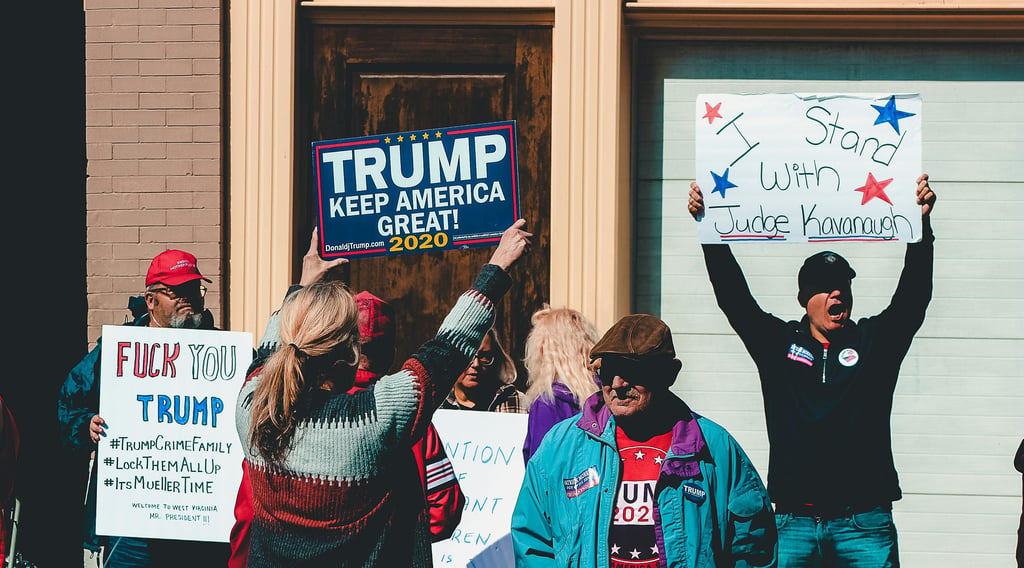
Political rally in Wheeling, West Virginia, supporting different 2020 election campaigns (credit: Rosemary Ketchum)
I’ve been thinking about the recent local elections and sentiments about the political environment changing in UK society. These have been the talking points of broadcasters, journalists, economists, public intellects, for a while now, but when it’s time for a national vote/poll, we hold our breath in anticipation to figure out if the predictions are right. If the pundits are right and if even we were right about how the nation feels.
Significant political change has been sweeping the world and if you follow me on LinkedIn, I recently shared a reflection on the last week’s vote, which was wondering if the recent vote felt like a ’Brexit 2.0’ of sorts. As a psychologist, working with people across ethnic, socio-economic and generational lines, I notice that the topic of politics is increasingly front of mind for my clients. They see me based on the individual challenges that they are working to overcome, but this is not divorced from the environment they are living in. Their neighbourhood, the nation at large and it’s politics.
In this Edition:
Exploring the theories behind ‘Affective Polarisation’
The ‘Global Picture’
Social Media: Is it an accelerant or amplifier?
What is Affective Polarisation?
Political scientists use a specific term for what many of us are observing: affective polarisation. It refers to the extent to which people feel more negatively toward supporters of other political parties than toward their own (Iyengar et al., 2019, as cited in Boxell, Gentzkow & Shapiro, 2022).
Notice what this means. It is not primarily about policy disagreement. It is about how we feel about the people on the other side. The animosity. The distrust. The instinctive recoil. And that emotional dimension is precisely what makes it psychologically significant.
The distinction matters. Two countries can have sharp policy disagreements and still have relatively low affective polarisation — people can disagree on immigration or taxation without despising each other. Conversely, affective polarisation can rise even when policy positions have barely shifted. What changes first is feeling, not thinking.
Global Picture (so far) - Is the world really getting more polarised?
Most of us assume the answer to this is a straightforward yes. But the data is more interesting.
Boxell, Gentzkow, and Shapiro (2022) measured affective polarisation trends across twelve OECD countries over four decades. Their headline finding: the United States experienced the largest increase of any country studied. In 1978, the average partisan rated in-party members 27.4 points higher on a feeling thermometer than out-party members. By 2020, that gap had grown to 56.3 points — more than doubled.
But here is the part that tends to get overlooked: not every country followed this trajectory. In six countries — Japan, Australia, Britain, Norway, Sweden, and Germany — affective polarisation actually fell over the same period.
"Six countries — including Britain — saw affective polarisation fall over the past four decades. Rising political division is not an inevitable feature of modern democracies."
Boxell, Gentzkow & Shapiro (2022)
That is a finding worth sitting with, especially for those of us in the UK. The sense that 'everything is more divided than ever' is genuine — it maps onto real lived experience. But the systematic data suggests the emotional landscape is more complex than the narrative of universal decline.
What drives the increase where it does occur? The researchers found that trends in the penetration of private 24-hour news networks and measures of elite polarisation showed positive associations with rising polarisation. How politicians and media behave shapes how citizens feel about each other. The tone at the top is not merely symbolic.
Importantly, the study found no significant association between internet use and rising affective polarisation at the cross-country level. That does not exonerate the internet — but it does suggest that social media is not the whole story.
Social Media: Accelerant or Amplifier?
Of course, we cannot talk about political polarisation in 2026 without talking about social media. The two have become so intertwined that it can be difficult to know where one ends and the other begins.
Arora and colleagues (2022), in a systematic review of the existing scholarship on polarisation and social media (published in Technological Forecasting and Social Change), identified several key mechanisms through which the two are linked. They point to three dynamics that make social media environments particularly fertile ground for polarisation: misinformation, affect-driven predisposition (letting emotion rather than evidence guide what we believe and share), and homophily-based interactions — the tendency to gravitate toward people who already agree with us.
Homophily is worth pausing on. The platforms we use are not neutral tools. They are designed to maximise engagement, and engagement tends to increase when content confirms what we already believe or outrages us about what others believe. The result is an information environment that systematically rewards division.
Arora et al. (2022) note that while social media's valence and strength of influence on polarisation remain debated, the structural conditions it creates — information diffusion at unprecedented scale, curated echo chambers, affect-driven sharing — have materially changed the landscape in which public deliberation occurs. And public deliberation, they argue, is one of the central pillars of a functional and progressive society.
"Interactions in the public sphere may give way to misinformation, affect-driven predisposition, and homophily-based interactions — all reminiscent of polarisation."
Arora et al. (2022)
There is something almost paradoxical here. The same technologies that allow minority voices to organise, that enable global solidarity, that let marginalised communities find each other — also create the algorithmic conditions that push people further apart. The platform's incentive structure does not distinguish between helpful engagement and harmful division.
Next time
In the next edition, I will take this much further — and it is the part that genuinely surprised me when I read the research. What does political polarisation actually do to your health? How does it affect your stress, your relationships, your social support networks?
The answers are not what most people expect. One study, for instance, found that changes in polarisation did not cause changes in wellbeing. It was the other way around. Your stress is shaping your politics more than your politics is shaping your stress.
I will also look at a question that has become part of the culture war itself: is psychology 'woke'? It is a claim being made with increasing frequency. The evidence behind it is, to put it generously, thin — but it deserves a proper examination.
The next edition will be out shortly. In the meantime, I would genuinely love to hear: how has the political climate been feeling for you? Reply here or reach me at info@latitudepsychology.com
Join the 'Global mind' Newsletter
info@latitudepsychology.com
+44-20-3714-8097
UK: 0203 714 8097
© 2024. All rights reserved.