Hobbies Aren't a Luxury. They're Infrastructure.
The case for hobbies as a foundational tool for productivity, not something to earn.
DEPRESSIONFOR BUSY PEOPLE
4/28/20266 min read
Overview
The relationship between hobbies and mental wellbeing - outcomes from studies with over 93,000 participants from across the world
Relationship between hobbies and ageing, lifesatisfaction and general mood
Social capital: The role of play and hobbies in maintaining relationships with other
Playfulness as an indicator of professional resilience!
Upward Spiral Theory: play as a device for personal growth
Plans for Part 2 - ‘Play for professionals’: organisations that have made provision for play in their workforce
Hobbies & Mental Health: What the Evidence Shows
Let’s start with the data. A 2025 scoping review by Cleary and colleagues examined decades of research on hobby engagement and mental health. Their analysis identified three consistent themes across the literature: hobbies reduce symptoms of depression, anxiety, and stress; they improve quality of life and wellbeing; and they support social interaction and connection. Importantly, these effects were observed across age groups, conditions, and hobby types — from creative arts to physical activity to community volunteering — and were not limited to those who were already well: people managing chronic illness, disability, and significant life stressors all showed meaningful gains (Cleary et al., 2025).
One of the most striking figures to emerge is this: people who engage in hobbies have approximately 30% lower odds of experiencing depression (cited in Cleary et al., 2025). That is not a trivial effect size. The difference between having a hobby and not having one may be comparable to the protective impact of other commonly recommended wellbeing practices — and unlike many interventions, it requires no prescription.
"People who engage in hobbies have approximately 30% lower odds of experiencing depression."
This finding is far from isolated. A landmark cross-national study drawing on data from 93,263 adults across 16 countries found that hobby engagement was associated with significantly fewer depressive symptoms, higher self-reported health, greater happiness, and higher life satisfaction — regardless of age, gender, employment status, or cultural background (Fancourt et al., 2023; Mak et al., 2023). The universality of these effects is particularly compelling: across nations as different as the United States, Japan, Indonesia, and South Africa, the pattern held.
(Cleary et al., 2025; Fancourt et al., 2020)
The benefits of hobbies extend well beyond symptom reduction. Research consistently shows that hobby engagement is associated with a richer sense of life satisfaction and subjective wellbeing — the kind of deep, evaluative sense that one’s life is going well (Mak et al., 2023).
In a large-scale longitudinal analysis, Mak and colleagues found that hobby participation in adults aged 65 and over was associated with better self-rated health, lower rates of depression, greater happiness, and higher life satisfaction — effects sustained over time and consistent across countries with very different health systems. The directionality of the data suggests hobbies are not merely a marker of pre-existing good health, but an active contributor to it.
The scoping review by Cleary and colleagues (2025) identifies purpose and meaning as key mechanisms through which hobbies support wellbeing. Engaging in activities we have chosen freely — especially those that stretch our skills or connect us to others — generates a sense of competence and personal agency that reinforces our broader psychological resources.
Beyond Mood: Quality of Life, Purpose and Longevity
The Social Dimension: Connection Through Shared Interests
One of the frequently underestimated benefits of hobbies is their capacity to build social bonds. Cleary and colleagues (2025) identified social interaction and community as a distinct pathway through which hobbies improve mental health — separate from, and additive to, the direct mood effects.
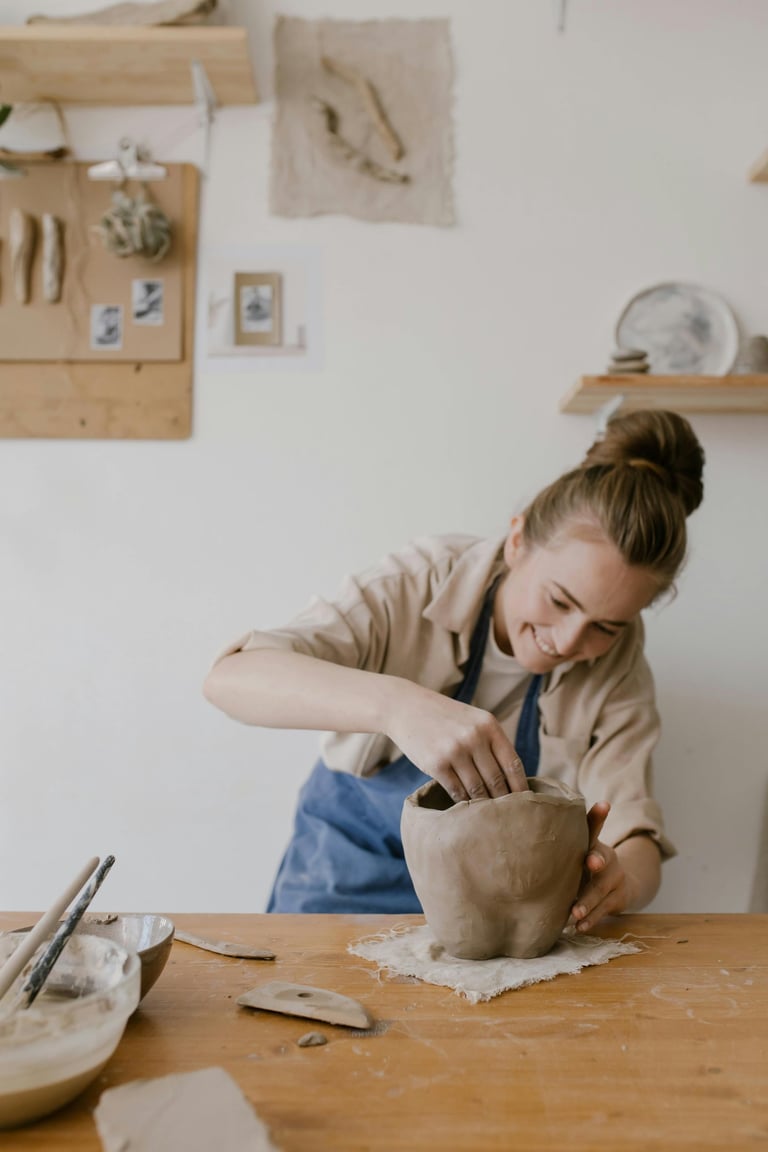
When we engage in hobbies alongside others — whether in a running group, a book club, a choir, or a pottery class — we experience a particular kind of social contact: low-stakes, low-pressure, and organised around shared interest rather than obligation. This is qualitatively different from social contact weighted by duty or professional expectation. It tends to be warm, voluntary, and mutually affirming — and for those navigating loneliness or major life transitions like retirement, relocation, or bereavement, this distinction matters greatly. Longitudinal evidence supports the point: hobby engagement predicted improved wellbeing even after controlling for baseline social factors, suggesting that the activity itself is building social capital, not simply reflecting it (Mak et al., 2023).


Play at Work: Adult Playfulness as a Coping Resource


Much of the discussion around hobbies assumes a clear boundary between leisure time and the rest of life. But recent research suggests that the playful orientation hobbies cultivate does not switch off when we return to work or face difficulty. It becomes a psychological resource we carry with us.
A 2024 study by Tandler and colleagues investigated adult playfulness as a predictor of coping strategies across two independent samples: student nurses and working professionals. Adults who scored higher on playfulness — those who were lighthearted, intellectually curious, and able to find levity in everyday situations — were significantly more likely to use adaptive coping strategies and significantly less likely to resort to avoidant or self-defeating ones (Tandler et al., 2024).
Playfulness, the researchers argue, is not merely a fixed personality trait but a capacity that can be developed. Hobbies — particularly those involving creativity, imagination, or social play — are one of the most natural environments in which that capacity is practised and reinforced.
So why do hobbies and play produce these effects? The most influential theoretical account comes from Barbara Fredrickson’s Broaden-and-Build Theory of Positive Emotions (2001), one of the most empirically supported frameworks in positive psychology.
The theory begins with a simple but powerful observation: positive emotions — joy, curiosity, contentment, love — do something distinct from negative ones. Where negative emotions narrow our attention and behaviour, priming us for fight, flight, or freeze, positive emotions broaden our thought-action repertoire. They make us more curious, more creative, more open to new perspectives. Joy, in particular, creates the urge to play, push limits, and explore (Fredrickson, 2001). And over time, these broadened states allow us to build enduring personal resources — physical, intellectual, social, and psychological — that sustain us when life becomes harder.
"Positive emotions broaden our thought-action repertoire and, over time, build the enduring personal resources — physical, intellectual, social, and psychological — that help us flourish. Hobbies are one of the most reliable generators of these positive emotional states."
Fredrickson also introduced the ‘undoing hypothesis’: positive emotions speed up cardiovascular and physiological recovery from stress and negative emotion. Play and enjoyment are not just pleasant diversions — they are biological correctives, actively restoring our systems after the wear of daily demands.
Perhaps the most encouraging implication of all this research is that the benefits of hobbies can be self-reinforcing.
Fredrickson and Joiner (2018) describe what they call Upward Spiral Theory : positive emotions do not simply cancel out negative ones on a ledger, but initiate dynamic, self-perpetuating processes of growth.
Here is how the spiral works in the context of hobby engagement: positive emotions experienced during play broaden our attention and awareness. That broadened state allows us to notice more, connect more, and build more. The resources accumulated — resilience, social bonds, skill, confidence — make it more likely we will seek out further positive experiences. Each engagement reinforces nonconscious motivational patterns that orient us toward wellbeing-sustaining behaviours (Fredrickson & Joiner, 2018). The positive feelings generated by something as simple as a painting class, a weekly football game, or an evening spent reading do not evaporate when the activity ends. They seed conditions for more wellbeing. They make the next positive experience more accessible.
The Science Behind It: Broaden and Build
Summary
The collective weight of this research points to something worth sitting with: treating hobbies as optional is not a neutral decision. It is, in effect, a decision to forgo a meaningful source of protection against depression, a reliable generator of life satisfaction, a training ground for resilience, and a mechanism for compounding wellbeing over time.
That is not to say that everyone needs to pick up a guitar or join a pottery class. The research is consistent that the specific content of a hobby matters less than the presence of genuine engagement — activities freely chosen, personally meaningful, and pursued with some regularity. The question to ask is not ‘what should my hobby be?’ but ‘what activities, when I engage in them, make me feel most alive?’
If you have been telling yourself that you will make time for the things you love once life settles down, the evidence suggests you might have the equation the wrong way around. The things you love are part of how you build the capacity to face what will not settle down.
Take away
On an individual level, developing a practice of play or times in the week for hobbies is essential for our health and professional growth. So spread the word that we need to protect our playtime!
In the next newsletter, we’ll look at some organisations (some big and some small) from around the world who have taken this seriously!
Cleary, T., and colleagues. (2025). Impact of hobbies on mental health and well-being: A scoping review. Mental Health Review Journal.
Fancourt, D., and colleagues. (2023). Hobbies and their associations with health and wellbeing: A longitudinal cross-country analysis. The Lancet.
Fredrickson, B. L. (2001). The role of positive emotions in positive psychology: The broaden-and-build theory of positive emotions. American Psychologist, 56(3), 218–226.
Fredrickson, B. L., & Joiner, T. (2018). Reflections and reviews: Positive affect and the complex dynamics of human flourishing. American Psychologist, 73(9), 1085–1094.
Mak, H. W., and colleagues. (2023). Longitudinal associations between hobby engagement and depressive symptoms, subjective health, happiness, and life satisfaction in adults aged 65 years and over. Nature Medicine.
Tandler, N., and colleagues. (2024). Adult playfulness and coping: Playful adults use more adaptive coping strategies than less playful ones. New Ideas in Psychology, 72, 101072.
References
Upward Spirals: How Play Compounds Over Time
Join the 'Global mind' Newsletter
info@latitudepsychology.com
+44-20-3714-8097
UK: 0203 714 8097
© 2024. All rights reserved.